What a cheap shipping container actually gets you
Practical advice on what a cheap shipping container actually gets you. Compare suitability, condition and the full delivered quote for your job.
We publish our prices, which makes this one of the few places you can find out what a container costs without ringing anybody first. It also means we get asked the harder question fairly often, usually by somebody who has been burnt by a purchase that kept billing after the purchase: what does it cost after that? Here is the honest itemisation — what you will spend in the first month, what you will spend across ten years, and the fairly long list of things a shipping container does not cost you at all.
Every figure on the prices page is a "from" price for the container itself, ex GST, ex depot. Delivery sits outside it and is quoted with the unit against your actual address, because what a truck costs depends on where it is going and what it finds when it arrives — which is why you will not find a delivery figure anywhere on this site.
Everything below is the third category: what you spend on the container once it is standing on your ground. None of it is enormous. Most of it is one-off. And a fair bit of it is optional in a way the seller has no incentive to tell you about.
A shipping container carries its entire weight on eight corner castings, and the four on the bottom are the ones that matter. Sit it square and level on all four and it will still shut properly in fifteen years. Sit it on three, or on ground that moves, and the frame twists — and a container racked out of square fights you every single time you close the doors. It cannot be economically fixed. It is the most expensive mistake available on this list and it happens on day one, usually because somebody was in a hurry.
What it takes is not much: something under each bottom corner that spreads the load onto firm ground and keeps the steel out of the dirt. Concrete pads, besser blocks or hardwood sleepers all do the job. Four of them, bought at a hardware store or a landscape yard, is the single cheapest insurance policy in this article.
The other half of it is free. Look at where it is going before delivery day, not on it. Ground that carries a loaded truck in September may not in February, and a spot that drains away from the doors will always be better than one that drains towards them.
A container door is not the weak point. The padlock is, and a standard padlock on a container is an invitation, because the shackle sits out in the open where bolt cutters reach it in about four seconds.
The fix is a lock box — a welded steel shroud over the locking bar that covers the padlock so nothing can get a jaw onto the shackle. Every unit we hire out has one fitted as standard. On a purchase it is worth asking about when you order, because retrofitting one later means somebody with a welder.
Then buy the lock properly. A closed-shackle, hardened, weather-rated padlock is the one that belongs inside a lock box; a brass hardware-store lock will be seized shut by salt air or rain inside two years, which is its own kind of security problem. This is a genuinely small amount of money against the value of what is usually going inside.
Shipping containers sweat. Warm, moist air inside meets a steel roof that has dropped below dew point overnight, condensation forms on the underside of the ceiling and then it drips. People report this as a leak and it very often is not — a cargo-worthy unit is checked wind and watertight before it leaves the depot, and that check is about rain arriving from above.
If the container gets opened most days, air moves and you will probably never think about it. If it is sealed for weeks at a time and holding anything that minds moisture, fit vents. A pair of louvre vents cut into opposite ends, high on one and low on the other, sets up enough cross-flow to deal with most of it. Add a couple of desiccant buckets for a sensitive load and keep everything up off the floor on pallets, which costs nothing if you have pallets.
Two things worth knowing before you cut anything. Vents are a modification, so if the unit is on hire rather than bought, ask first.
Corten steel is designed to form a stable surface oxide and then largely stop, which is why used containers are covered in rust and still perfectly sound. Left entirely alone on an inland block, a cargo-worthy unit will look worse every year and take a very long time to become a problem.
Two situations change that. Salt air, within a few kilometres of the coast, accelerates everything and concentrates it on the roof and the door hardware. And any spot where water sits and does not drain — the bottom rail, the underside of the door sill, a dented roof panel holding a puddle — is where perforation actually starts, because rust needs standing water more than it needs time.
The maintenance is unglamorous and cheap. Once a year, walk around it: clear leaves and debris off the roof so water runs off, wire-brush any spot that has gone past surface rust and hit it with a rust converter and a coat of enamel, and put a shot of lanolin spray or grease through the door hinges and locking bars. Half an hour and a few tins. Do that and a full repaint — which is a weekend with a roller and a few litres of paint, not a trade job — becomes something you do once a decade if you feel like it, rather than a rescue mission.
Container floors are marine ply, usually 28mm, and on a used unit they will be stained because they have carried things. Staining is not damage. A floor only becomes a cost in two ways: something gets spilled on it and left, or water has been getting in for long enough to soften it.
If you are storing anything that might leak — drums, chemicals, a mower with fuel in it — a sheet of ply, a rubber mat or a drip tray under it is a few dollars against a floor section that has to be cut out and replaced. And if the unit is going to be walked on constantly with steel-capped boots and dragged pallets, the same sheet of ply saves the real floor underneath it.
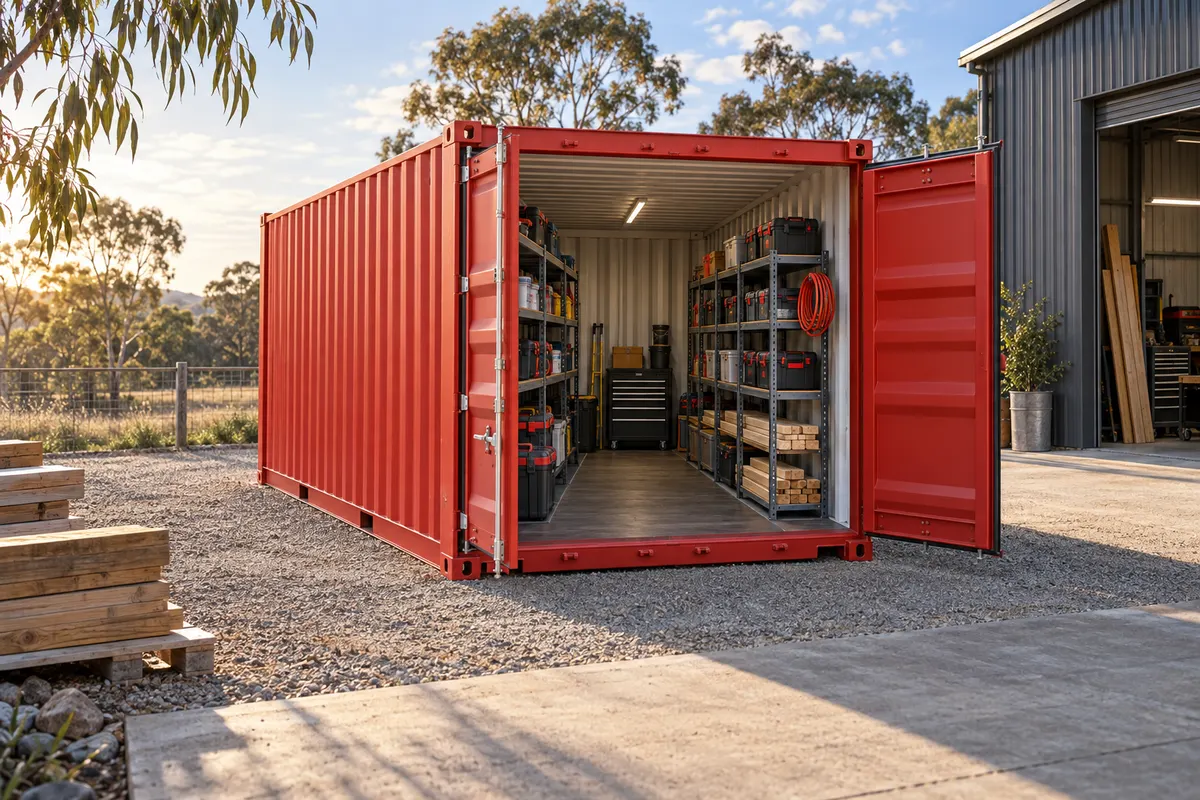
This is the line item that varies most, because it runs from a few pallets standing on the floor to a full racking fitout. It is also the one worth thinking about before you choose the size, not after.
The mistake is buying a container for its floor area and then discovering the volume is in the height. A 20ft is 33 cubic metres and a great deal of that is above head level, which is doing nothing at all unless something is holding your gear up there. Cheap steel shelving down one wall roughly doubles what a container usefully holds, and it costs a fraction of the difference between a 20ft and a 40ft. Work out the shelving before you work out the size and you will sometimes find you did not need the bigger box.
This is the part that rarely gets said, and it is the reason the sums work.
Worth checking rather than assuming: whether your local council has anything to say about a container on a residential block, which varies by area and by whether it is temporary, and whether your insurer wants to know about it and about what is inside it. Neither is usually a cost. Both are a five-minute phone call that is much better made before the truck than after.
Our team can quote the container and delivery together. Share the size, condition and suburb, and compare the complete written quote before booking.
| Item | What to plan |
|---|---|
| Ground and supports | Confirm the preparation and supports needed for your site with the delivery team. |
| Security | Consider a suitable padlock and lock box for the location and contents. |
| Ventilation | Discuss moisture-sensitive storage and any modifications before proceeding. |
| Maintenance | Inspect seals, drainage and surface rust; coastal exposure may need more attention. |
Everything else on the list is a choice, and most of it is a choice you make years later.
One thing does work in the other direction, and it is the reason the ownership sums on a container look nothing like the sums on most things you buy: at the end of it you still own a large steel box, and there is a real second-hand market for large steel boxes. A unit that has been sat level, kept out of standing water and had its doors greased is worth meaningfully more at that point than one that has been left to seize on soft ground — which is a reasonable summary of everything above.
Our team can quote the container and delivery together. Share the size, condition and suburb, and compare the complete written quote before booking.
Each quote confirms the container, delivery and GST for your job. Availability, condition and site access are checked before booking.
Practical advice on what a cheap shipping container actually gets you. Compare suitability, condition and the full delivered quote for your job.
What the grade names actually mean, what each one guarantees, and how to read a listing that does not say which grade it is selling.
Why nobody can honestly publish a flat national delivery price, the six things that actually move the number, and how to get a delivered figure for your own address.
Tell us what you need and where it is going for a container and delivery quote.
Prefer a chat? Give our team a call.
Call 1300 639 282